Movement with Meaning

Real people are never still. Gesture and movement are part of our language. They usually complement what’s being said, but they can also tell us things the speaker didn’t mean for us to know. Our experience of people guides our interpretation. Because readers come equipped to understand body language, writers can use it to show rather than tell. We don’t want to clutter the page with insignificant movements that readers will simply tune out (see Resisting Your Own Autosuggest), but well-chosen gestures and movements present opportunities for writers:

1. Enriching Character. Distinctive, authentic gestures convey personality. We recognize people by the way they do things. In Donna Tartt’s The Goldfinch, when Boris pulls his chin back or pinches his nostrils shut, we feel that we know him. Only he would blow his nose sloppily, inspect the contents of the Kleenex and wince (p. 564). Body language can also open up depth, especially in characters reluctant to reveal themselves. When Boris leaves Theo behind in that scene – “his gait loosening and lightening as soon as he thought he was out of my view” (p. 565) – we immediately grasp that Boris has been hiding something from Theo and realize how tenuous their bond has become.

2. Invoking Sympathy. Small movements can be a subterranean way of engendering sympathy for characters who evoke a mixed response. An example here could be an embittered woman speaking hard truths to a child, but having that woman’s hands open for a moment, then close as if with regret. Imagined actions can be even more subtle – those considered and not taken – as contemplated within a close point of view. In Olive Kitteridge by Elizabeth Strout (p. 180): “She would like to rest a hand on Marlene’s head, but this is not the kind of thing Olive is especially able to do. So she goes and stands near the chair Marlene sits on, gazing out that side window there, looking down at the shoreline….” Olive’s urge to touch Marlene makes her sympathetic, but her inability to do so is heartbreaking.

3. Creating Layers. Gestures and staging can contrast with narration and dialogue to set up an unreliable narrator, in books such as Gone Girl by Gillian Flynn and The Girl on The Train by Paula Hawkins. They act as our clues. Contrasts like these can also be mined for irony and humor or built up to increase the tension. Jennifer Egan does both in A Visit from the Goon Squad (pp. 180-183) when, in contrast to the typical back and forth of an entertainment interview, the reporter keeps taking little inappropriate actions such as staring at the movie star’s legs. Finally, he experiences an urge to push her back on the grass and then does, which launches a scene of full-blown action, while retaining the tone of dark absurdist comedy.

4. Marking Transitions. Movement can be of great practical use to a writer. For instance, small actions can be used in place of attributions like “said.” Movement draws the reader’s attention; we assume whoever moves is the one who speaks. Similarly, gestures can help us to transition between current time and memory or between dialogue and thought. Not only does movement draw the eye, a gesture can carry a sense of intimacy that invites us deeper. In Colum McCann’s Let the Great World Spin (p. 330), we move seamlessly from outside to inside the character of Jaslyn: “She rubs her hands together, nervously. Why, still, this small feeling of tightness at her core?”

5. Inspiring Discoveries. Gestures are easy for writers to improvise – to try on, if you will. They may open up paths we didn’t know we were on. They encourage us to surprise ourselves by making our scenes more real and vivid and may lead us to unexpected discoveries. All of us – writers as well as readers – interpret body language without consciously meaning to. Remember always to picture how your characters would move as they speak and listen and think, and you may find yourself learning something important and new about them.


Leading Against Your Strengths

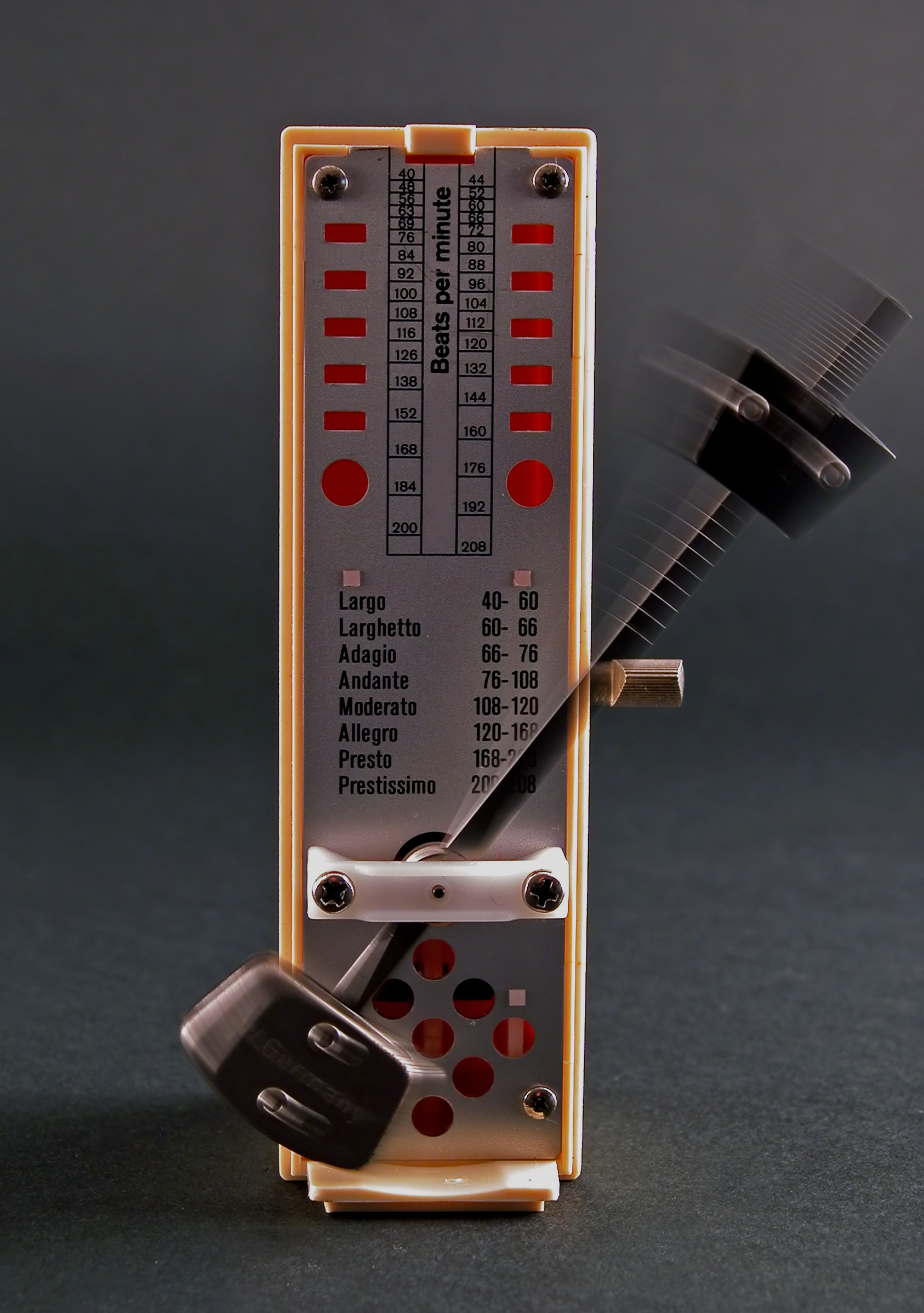
Practice is necessary to the development of skills in every field, from work to sports to Metronomeart. Watching Wimbledon this week reminds me of the hours I put into tennis when I was a kid, tossing balls in the air to practice my serve over chalked marks in the driveway, hitting shots against our uneven garage door. Originally my backhand was lousy, but years of leading with it in practice turned it into my best shot. In Jeremy Denk’s fascinating article on his life in piano lessons (“Every Good Boy Does Fine,” The New Yorker, April 8, 2013), he quoted his teacher, the Hungarian pianist György Sebők, as saying that you don’t teach piano playing at lessons; you teach how to practice. Practice is where the learning occurs. Good students know what they need to drill.

Writing is unusual in that the most intense practice happens in the course of writing drafts. Even if we attend classes, keep a journal or follow writing prompts, the real work of improving our writing takes place on the ground. We practice on the very same pieces that will become our finished product. Everything that goes into that – all the brainstorming, outlining, writing and rewriting – is both part of perfecting a particular manuscript and part of learning our craft.

I’d like to suggest that you structure your approach to new work with a view to pushing yourself in your areas of weakness. I don’t mean that you should tamper with what inspires you, whether you begin with a character, a plot, an insight or something else. My suggestion comes at the next stage, when you begin to outline or brainstorm scenes. If you’re great with character but weak on plot, then push yourself to consider the what if’s of plot – to get some ideas on the table. If you’re great with plot, then try to invest some early work in your characters. If dialog is your best shot, then experiment with action and description. If description, then make your characters talk. We all have to deal with our weaknesses when we’re revising: the idea here would be to increase your awareness of those areas at the outset – not only to enrich the manuscript in front of you, but to work on your mastery of writing skills.

Once your manuscript gets going, you’ll naturally play to your strengths. You won’t be able to help yourself from paying attention to the aspects of writing that you love. But if you start by leading against your strengths, then over time your weaknesses should improve in a more integral way, rather than just being something other people always have to tell you to fix at the end.

You know better than anyone else what needs work. Own it. Drill it. Be brave.


The Truth Behind Fiction

Fiction is a lie that tells truth – I’ve seen versions of that insight attributed to authors from Albert Camus to Stephen King. What I’d like to emphasize here is that the truth they’re talking about is yours. Your own truth underlies your writing even if you don’t always realize it. The urge to write fiction represents a kind of sounding – you’re drawn to a particular character or sequence of events because they resonate with you. They connect with something deep inside you that yearns to get expressed, something about life that you believe to be important and true. Something that matters intensely to you.

I’m not talking about truisms. In The Kite Runner by Khaled Hosseini, the truth I sense isn’t simply that war is bad or that people can be evil or that Afghanistan is a scary place. If you think specifically of Amir, the protagonist, and his journey, you can feel it pushing at him throughout the story: the evil of others doesn’t acquit you – responsibility is part of love. In Middlesex by Jeffrey Eugenides, in which Calliope, a hermaphrodite, is raised as a girl but emerges from puberty as a man, the truth has more teeth than mere acceptance of self. It’s about accepting what you feel to real and true, however bizarre it may seem. In contrast, consider Life of Pi by Yann Mantel, the story of young Piscine Molitor Patel and his survival on a lifeboat with an adult Bengal tiger, when another layer gets added that makes it seem as if the whole thing was a lie hiding a more desperate reality. But readers know which they feel called to believe. This book makes the case that stories may hold more truth than mere facts.

I don’t know why these truths matter to these authors, but I can tell that they do. These books reverberate with the power and authority of personal truth.

Writers don’t have to be able to articulate this at the outset. What you believe as expressed through your words can be something you discover through your writing. Our most startling insights often happen that way. But at some point, one way or the other, you want to go looking for the deepest connection between yourself, your characters, and your story. Ask yourself, what is it about this that matters so much to me? What is it that I most want these characters, and my readers, to hear?

Dara Marks discusses this in her excellent work on screenwriting, Inside Story – The Power of the Transformational Arc, and her advice applies to writing books for adults and children as well. You want your protagonist to have traits in resistance to your central truth – to need the journey to get there. You want your plot to include circumstances that challenge that resistance until it breaks. She cites John Keats: “Do you not see how necessary a world of pains and troubles is to school an intelligence and make a soul?”

F. Scott Fitzgerald, author of The Great Gatsby and This Side of Paradise, says this in a somewhat daunting letter to a young would-be writer:

I’ve read the story carefully and, Frances, I’m afraid the price for doing professional work is a good deal higher than you are prepared to pay at present. You’ve got to sell your heart, your strongest reaction, not the little minor things that only touch you lightly, the little experiences that you might tell at dinner. . . . This is the experience of all writers. It was necessary for Dickens to put into Oliver Twist the child’s passionate resentment at being abused and starved that had haunted his whole childhood. Ernest Hemingway’s first stories In Our Time went right down to the bottom of all that he had ever felt and known. In This Side of Paradise I wrote about a love affair that was still bleeding as fresh as the skin wound on a haemophile.

You don’t need to share your characters’ same experiences for them to tell a truth that your own life has taught you. But if you aren’t in there somewhere, then you haven’t gone deep enough. Yet.

Photo courtesy of Todd Arkebauer.